
project Published
Waystation.
A tabletop RPG set in a Victorian afterlife, with light rules and a focus on roleplay and detective stories.
- Project date
- October 2026
- Tools
- N/A
- Original article language
- Russian
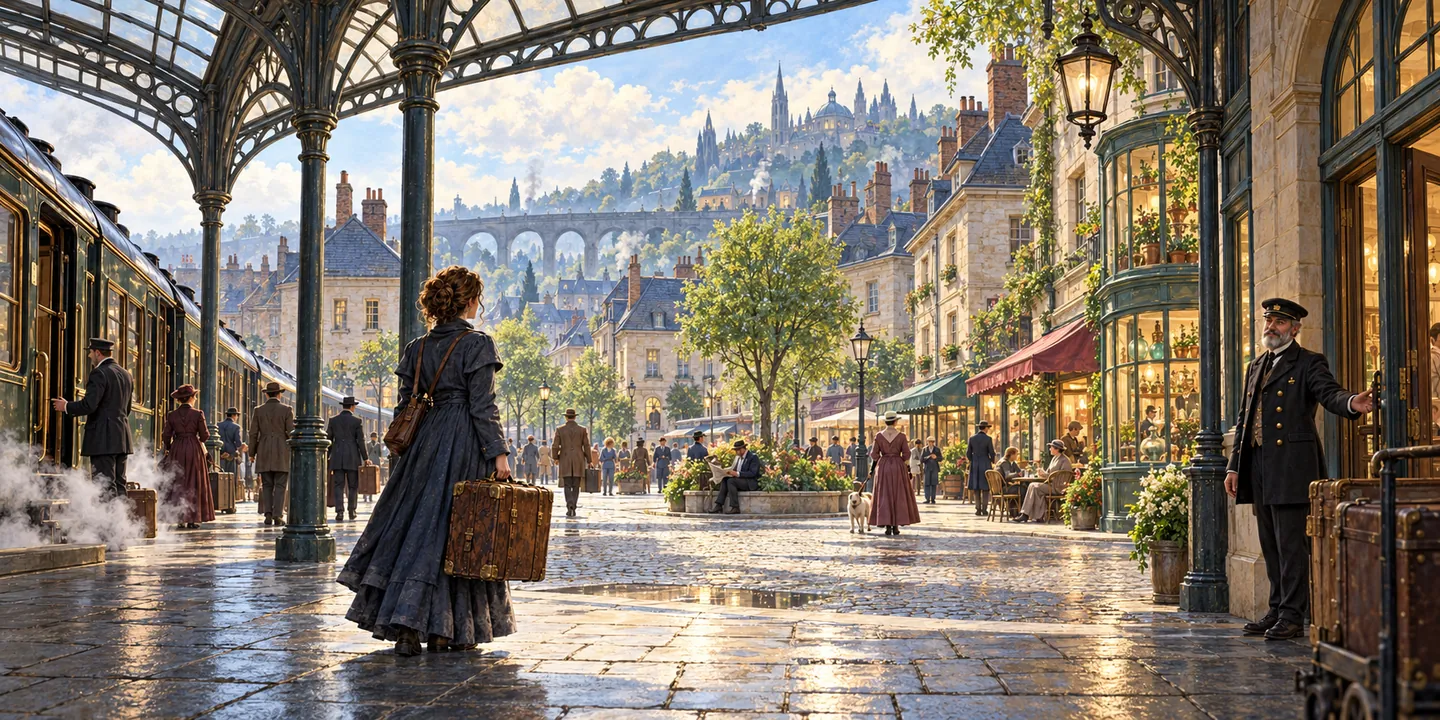
I love playing tabletop RPGs, though mostly I love running them. For the last couple of years I’ve been running D&D and playing Vampire: The Masquerade (VTM).
And then it was time to start designing another D&D campaign. I’ve got my own Victorian noir world, a bunch of NPCs with personalities and voices I’ve worked out, and a political situation already in place. I have a campaign and half a dozen one-shots under my belt. I don’t have players.
One couple in my group decided they wanted to have kids more than they wanted to keep playing with me. I still can’t believe this betrayal.
In any case, I wasn’t that keen to keep playing D&D. I don’t use a big chunk of the mechanics anyway. For example, in eight months of playing almost every week, we only had two proper fights, one in the first session and one in the last.
What I like most about tabletop RPGs is roleplaying, exploring the world, and doing detective work.
Trying to find players highlights another problem with D&D. There’s a lot to learn before you play. When I invite people to join, they’re very surprised to find out that, at best, they’re looking at a couple of hours of YouTube videos and another hour making a character. At worst, I send them the Player’s Handbook, which has a pretty terrifying effect.
I tried to find a tabletop RPG system that suited my needs better, but none fit well enough. Besides, my prospective players hadn’t heard of anything other than D&D anyway. So I decided to write my own system.
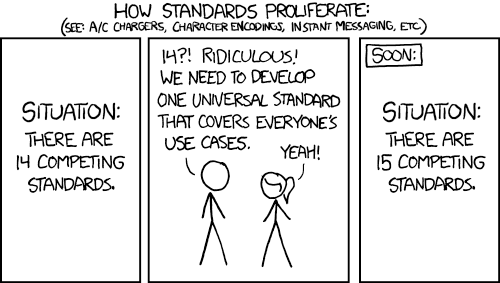
Randall Munroe, “Standards” (xkcd) · CC BY-NC 2.5
I insist this isn’t what’s happening in the comic. I’m not proposing any kind of standard. Realistically, I know my table is the only one that’s going to play this game. So why not tailor it to exactly what I want?
Design requirements
- A compact urban setting
- A focus on roleplay and characters
- Detective stories
- A minimal set of rules and simple character creation
Problems
- I’ve never designed a tabletop RPG.
- I’ve never thought mechanics mattered much. The atmosphere at the table matters a lot more, and so does inviting good people to play.
- I’ve played D&D and VTM, plus one game of Fate.
It’s very hard to tell what should be the designer’s responsibility and what should be the game master’s.
I like World of Darkness’s approach to building a clearly defined, richly detailed world a little too much. So I decided my game would have a codified setting too.
Setting
As I said, I wanted a Victorian aesthetic, and I eventually settled on 1895. The Industrial Revolution is over, and electrification is only just beginning. Socialist ideas are bubbling away underground in Europe while the bourgeoisie is making money off the workers. Literacy is becoming fairly widespread in cities, even if it isn’t universal.
I decided to borrow the main idea for the setting from my D&D campaign. I’d already stolen it from another campaign I’d played in. The world of Waystation (the name of the game, the setting, and the city) is the afterlife. The characters die on Earth and wake up in a train compartment a minute before arriving in Waystation. I suspect I also borrowed from Wraith: The Oblivion without realising it. I’ve never played it, but I used to watch a lot of videos about the setting.
I like how the player and the character are in sync here. Neither knows anything about the world they’ve landed in, and they get to explore it together.
Mechanics
I decided to borrow the core mechanics from World of Darkness.
How rolls work in VTM (optional reading)
In VTM, when a player wants to do something with an uncertain outcome, the Storyteller chooses the attribute and skill that fit the situation best. Strength + Brawl if the character wants to land a punch, or Composure + Etiquette to save face in a social situation. Players have ratings from 1 to 5 in their attributes and skills. They add the two ratings and roll that many d10s.
For Waystation, I decided to borrow this system and simplify it.
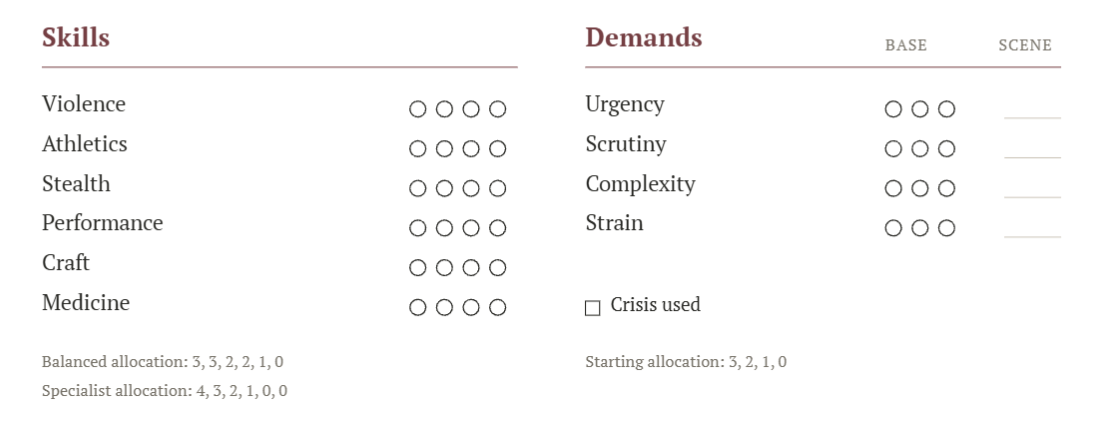
Just six skills instead of VTM’s twenty-seven and four demands instead of nine attributes. The circumstances of the action determine the demand. In VTM, the attributes describe the character. Urgency when time is the main issue. Scrutiny when people are watching the character. Complexity when it takes concentration. Strain when… the situation is stressful.
Take the same examples. In Waystation, if a fight has already started, you roll Violence + Urgency to make a melee attack (or any attack, really). If the target has no idea there’s violence coming their way, there’s no reason to roll. The violence will be carried out successfully. To save face in a social situation, the Director (that’s what Waystation calls the GM) will ask for Performance + Strain or Performance + Scrutiny, depending on the specifics and their read of what’s happening. Players roll d6s instead of d10s.
What we’re playing
This part is more up to the Director. Luckily, I’m both the designer and the Director. I wrote a one-shot for the system. I ran the first session. The one-shot got out of hand, and now it’s a campaign.
The player characters
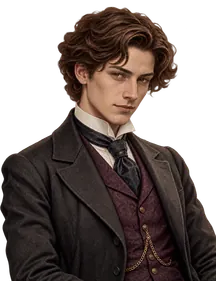
a con artist
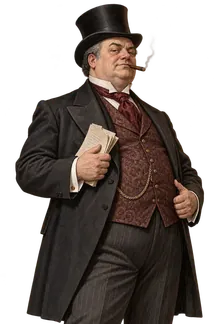
a lending magnate
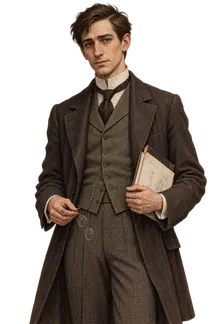
a patent office employee
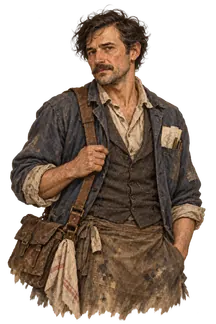
a mechanic and inventor

just a guy from Novgorod
Two of my five players are women, and I still ended up with a sausage party.
The players wake up in a train compartment with one other new arrival, an NPC called Pavel. To my relief, they immediately get into character and start panicking. The train stops, and the stationmaster opens the compartment door to invite the newcomers to the Arrival and Settlement Service.
In a small building right at the end of the platform, they talk to Marta and more or less accept that they really did die. Marta promises some help getting settled and sends the characters to rooms at Lantern House, paid for by the Service. Edward protests. He had a huge 200-kilo crate among his luggage. Marta assures him the porter has already set off for the boarding house with all the luggage.
Steven and Edward decide to pop into a pharmacy on the way. They’re annoyed to find that they have to pay for medicine and that Earth money is no good here. They also watch the pharmacist, Selim Arslan, move bottles of medicine around with his mind. Steven tries to work out whether the pharmacy would be a good investment. He rolls Craft + Complexity successfully, and the Director tells him what he can see. There aren’t many customers, the shelves are dusty, and Selim has bags under his eyes. Business probably isn’t great.
On their way out, Selim gives them some cryptic advice. Don’t shake anyone’s hand without gloves. He refuses to elaborate further. The characters are perplexed. They also notice that nobody on the street follows this rule. Plenty of people walk around shaking hands barehanded.
I think I’ll stop recapping the game in detail here. Suffice it to say that everything went sideways. I screwed up the setup and the intrigue, the players scattered into the open world to buy winter boots and pawn their jewellery, and we got nothing done. Steven’s roll at the pharmacy was the only roll in the first session, and Edward’s precious crate did get stolen after all.
There was a second session too. I gave up trying to steer the players through the plot and sent them off to wander the open world. It was pretty boring.
Then some unpleasant stuff happened in my life, and I put the design and the games on pause. I’m writing this article to document what we have so far.
Maybe I’ll keep writing and running games. Maybe Waystation will stay in the drawer with my unfinished projects. In any case, I’m attaching the Player’s Handbook. Give it a read and have a look at the pictures. They’re very stylish, at any rate.